
Login
Call Us



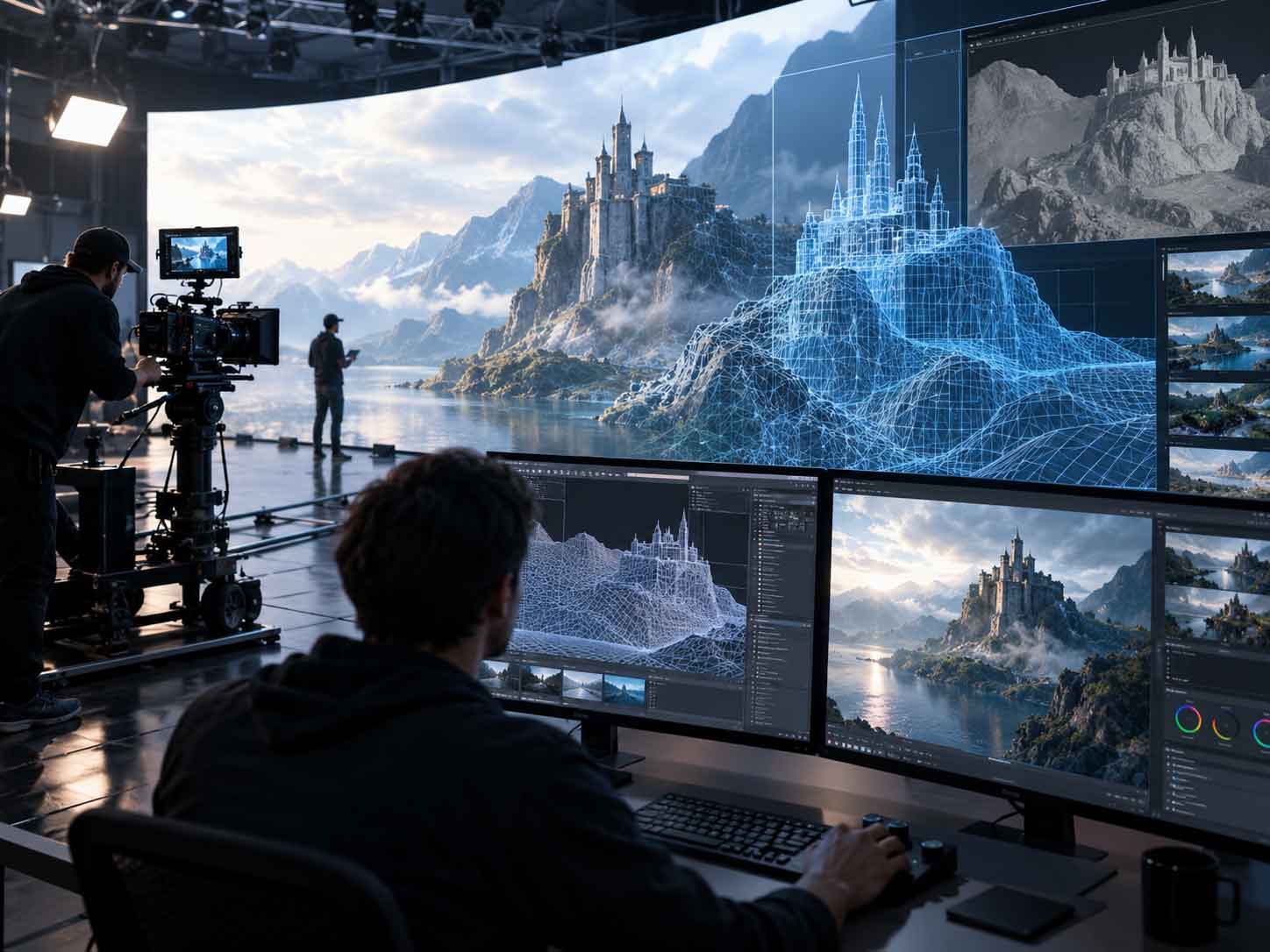
The CGI and visual effects industry is moving beyond isolated technological breakthroughs toward integrated, more efficient production pipelines. In 2026, artificial intelligence, real-time rendering, virtual production and cloud-based collaboration are changing how digital content is designed, created and delivered. The biggest opportunity is no longer simply producing more spectacular imagery, but giving creative teams greater control over quality, iteration and production costs.
Artificial intelligence remains one of the most significant developments in visual effects, but its practical value is increasingly found in specific production tasks rather than fully automated filmmaking. Rotoscoping, object isolation, cleanup, tracking, asset development and early visual exploration are among the areas where AI-assisted tools can reduce repetitive work and accelerate iteration.
An August 2026 analysis by Roland Berger examined how AI is changing VFX execution, highlighting the importance of automating structured, repeatable tasks while retaining human oversight. The distinction matters: generating an initial image or isolating an object is not the same as delivering a finished shot that meets a director's expectations for lighting, continuity, performance and visual consistency.
For studios, the competitive advantage will depend on how well these tools integrate into existing pipelines. Artists still need to evaluate outputs, correct errors and maintain a consistent visual language across hundreds or thousands of frames. Intellectual property, licensing, consent and data security are also becoming essential considerations when introducing generative systems into professional production.
The most effective approach is therefore selective automation. Rather than replacing an entire department with a single AI platform, studios can use targeted tools to shorten specific stages of production and redirect more time toward creative decisions.
Game-engine technology is increasingly influencing high-end film and television workflows. Real-time rendering allows filmmakers to explore environments, lighting, camera movements and visual effects with immediate feedback instead of waiting for lengthy rendering and review cycles.
At SIGGRAPH 2026, industry discussions highlighted how real-time previsualization is evolving from a planning exercise into a tool that informs creative decisions throughout production. More detailed environments, virtual cameras, motion capture and increasingly sophisticated lighting simulations allow teams to test ideas earlier and identify problems before expensive downstream work begins.
Developments presented at SIGGRAPH also demonstrate efforts to bring game-engine rendering closer to conventional post-production requirements. These include more flexible lighting outputs and improved integration with compositing workflows, helping artists retain control over individual lighting contributions rather than treating a rendered image as a finished, uneditable result.
However, real-time does not automatically mean final-quality. Complex reflections, translucent materials, volumetric effects, hair and demanding lighting conditions can still expose technical limitations. Production teams must balance speed with image quality and ensure that real-time assets remain compatible with the rest of the pipeline.
The direction is clear: real-time technology is becoming a creative and operational tool, not merely a way to produce rough previews.
Virtual production continues to reshape the relationship between physical filmmaking and digital environments. LED stages, camera tracking and real-time backgrounds can allow actors and cinematographers to work within a digitally constructed setting while seeing important visual elements during filming.
By May 2026, industry assessments were examining how far virtual production had progressed since its rapid expansion earlier in the decade. The technology is becoming more established, but adoption remains uneven because equipment, studio space, specialist staff and technical integration can be expensive.
The most useful development is not simply the ability to replace a distant location with a digital landscape. Virtual production can bring cinematography, visual effects, production design and technical planning into closer collaboration. Decisions about perspective, lighting, camera movement and environmental interaction can be tested earlier, potentially reducing costly revisions later.
AI-assisted tools are also beginning to support virtual production workflows, from asset development to digital set reconstruction and animation. A technical paper published in September 2026 explored an integrated workflow combining Unreal Engine, generative AI, computer vision and 3D reconstruction for digital assets and production environments.
Nevertheless, LED volumes are not a universal replacement for location shooting or traditional compositing. Their value depends on the requirements of each production. For some projects, a hybrid approach—combining practical locations, digital extensions and selected virtual-production stages—will remain the most efficient option.
Visual quality remains essential, but studios are under pressure to deliver increasingly complex work within tighter budgets and schedules. This is making pipeline integration, asset reuse, collaboration and reliable delivery just as important as individual rendering technologies.
Cloud-based workflows can help geographically distributed teams share assets, review shots and access scalable computing resources. Meanwhile, standardized scene data and reusable digital assets can reduce duplicated work across departments and projects. These benefits depend on strong technical infrastructure, predictable version control and clear responsibility for approvals.
AI adds another layer of complexity. A 2026 Perforce survey of more than 600 practitioners across real-time technology industries examined the growth of generative AI and the challenges surrounding productivity, governance and job security. Its findings reinforce a central industry issue: producing more digital assets is useful only when teams can manage, review and integrate them effectively.
This also changes the skills studios need. Artists who understand both creative fundamentals and technical workflows can help bridge the gap between traditional VFX departments and newer AI-assisted production systems. Technical directors, pipeline developers, supervisors and artists with strong problem-solving skills will remain important to maintaining consistency across complex projects.
Ultimately, the strongest studios will not necessarily be those using the largest number of new tools. They will be the ones that select the right technologies, protect creative control and build workflows that deliver predictable results.
The defining CGI and VFX trend in 2026 is convergence. Artificial intelligence is accelerating selected tasks, real-time rendering is improving creative iteration, and virtual production is bringing digital environments further into live-action filmmaking. Cloud infrastructure and integrated pipelines help connect these developments into a more coordinated production process.
None of these technologies removes the need for artistic judgment, technical expertise or careful supervision. Instead, they change where time and effort are spent. As repetitive work becomes easier to automate, visual storytelling, image quality, continuity and creative problem-solving become even more important.
For studios, freelancers and production companies, the practical priority is to adopt technologies that solve measurable problems rather than chase every new release. The future of digital production will be shaped not by automation alone, but by the ability to combine technical innovation with the craft of making compelling images.